A cylinder-head assembly can look similar across listings while differing in application, mounting layout or included parts. A wholesale quotation is easier to compare when the buyer and supplier identify the same configuration before discussing price.
Quick answer: Send motorcycle make, model, year and market, engine code, readable part reference, clear photos and quantity by configuration. Ask the supplier to confirm application, mounting pattern, assembly contents, MOQ and quote scope in writing. A model or displacement label by itself is not fitment proof.
Why is a model name or cc label not enough?
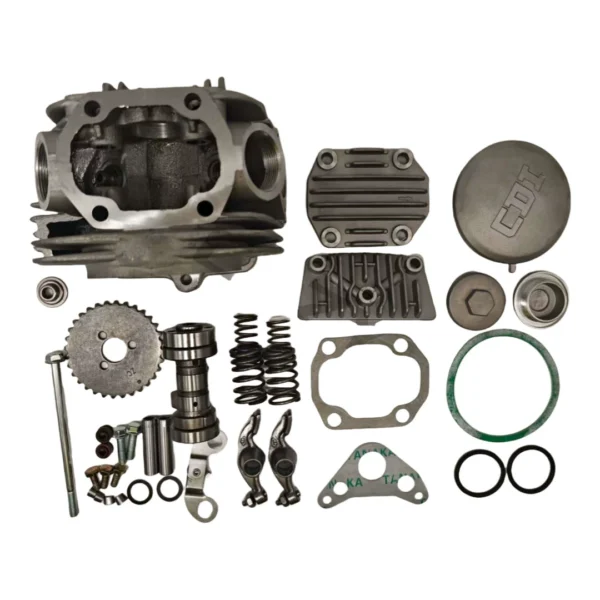
A model-family or displacement label narrows a search, but may not identify the exact engine revision, market version or part configuration. The current catalog includes two horizontal 125cc cylinder-head listings labeled single-mount and double-mount; their application fields are not provided. Other listing labels include Dayang DY100, Honda WAVE100, T110 and TITAN150/NXR150 with reference 12220-KRM-840. Treat these as catalog identifiers to verify against the buyer’s actual engine, not proof that one part fits every year or variant.
Compare the single-mount 125cc listing with the double-mount 125cc listing. Ask the supplier to identify the distinguishing mounting points and intended application for the exact SKU. A photograph alone cannot establish dimensions or compatibility. The TITAN150/NXR150 reference listing should also be checked against the buyer’s original part number and engine details.
What should a cylinder-head RFQ include?
Engine identity
Buyer sends: Make, model, year, destination market and engine code where available. Supplier confirms: Exact listed application and any unresolved variant.
Part identity
Buyer sends: Buyer SKU, original part number or readable markings. Supplier confirms: Whether the reference matches the requested listing.
Photos and dimensions
Buyer sends: Old part from multiple angles, mounting side, ports and a scale reference, plus measurements with units and measurement points or a drawing revision. Supplier confirms: Which visible features identify the configuration and the relevant interface and mounting measurements.
Assembly scope
Buyer sends: Whether the request is for a head, semi-assembly or another form. Supplier confirms: Included components, quantity per set and exclusions.
Order terms
Buyer sends: Quantity by SKU, sample requirement and destination. Supplier confirms: MOQ per SKU, quantity breaks, packing, lead time, quote validity and freight basis.
Ask for values that apply to the exact SKU, not generic figures for a model family. Keep unknown fields marked “not provided” until the supplier returns a drawing, measurement or written clarification. This prevents details from one variant being copied onto another and makes quotations comparable.
How should buyers compare wholesale quotations?
- Match the buyer SKU and supplier reference on every quotation line.
- Compare the same configuration and assembly contents, not just similar titles.
- Compare MOQ and price breaks at the same quantity and packing unit.
- Separate product price from freight, insurance, duties and destination costs.
- Record the sample, drawing revision, packing and lead-time assumptions.
Ask the supplier to return one row per configuration and mark any unconfirmed application or measurement explicitly. A lower price is not like-for-like if assembly scope, pack unit or freight basis differs.
What should the first sample check?
Compare the sample with the written quotation and supplier-confirmed drawing. Check that the SKU and package label match, the stated assembly contents are present, and measured points agree with the approved record. If installation testing is needed, have a qualified technician assess it on the intended engine before production approval. Photograph and measure discrepancies, then request written disposition. Keep the approved sample reference, drawing revision, buyer SKU and approval date together.
Copy-and-send cylinder-head RFQ template
Buyer SKU / listing: [ ]
Motorcycle make and model: [ ]. Year / market: [ ]. Engine code: [ ].
Original part number or readable markings: [ ].
Requested form: [head / semi-assembly / other]. Quantity by configuration: [ ].
Photos, drawing revision and measurement points attached: [ ].
Please confirm application, mounting layout, dimensions relevant to this SKU, included components and pack unit. Mark unconfirmed fields as “not provided.”
Please quote MOQ, sample terms, quantity breaks, lead time, quote validity, packing dimensions and gross weight. State whether freight is included.
Destination country / port: [ ].
Frequently asked questions
Does a 125cc cylinder head fit every 125cc engine?
No. Displacement alone does not identify mounting layout, engine revision or assembly scope. Confirm the engine code, original part reference and supplier-stated measurements for the exact listing.
What if the application is missing from a listing?
Send model and engine details, reference number and clear photos. Ask the supplier to identify the intended application in writing before relying on it in a purchase order.
Should a cylinder-head quote include every valve-train part?
Do not assume that. Request an itemized component list. For separately listed components, see our motorcycle valve-train fitment guide.
Request a written fitment review
Browse the cylinder and cylinder-head parts category, then send the selected listing, engine details, photos, quantities and destination through our sourcing contact page. Ask for written confirmation of application, assembly contents and quote scope. Availability and final terms must be reconfirmed in the supplier quotation.