Quick answer: A motorcycle brake fluid reservoir wholesale RFQ should identify the hose option, vehicle make, model, year and market, the part reference, clear photos, quantity by option and destination. Ask the supplier to confirm the mounting and outlet interfaces, included cap or hardware, brake-fluid system compatibility, current MOQ, availability, packaging and freight in writing. VOBOM’s current listing has two options—reservoir without hose and reservoir with hose—and lists “off-road motorcycle” as the application; that label does not confirm fitment for every model.
- Quote the reservoir with hose and without hose as separate order lines.
- Send model/year/market details and photos of the original part and mounting area.
- Ask for a dimensioned drawing and a written list of included components.
- Confirm compatibility, current MOQ, price basis and shipping before approving a bulk order.
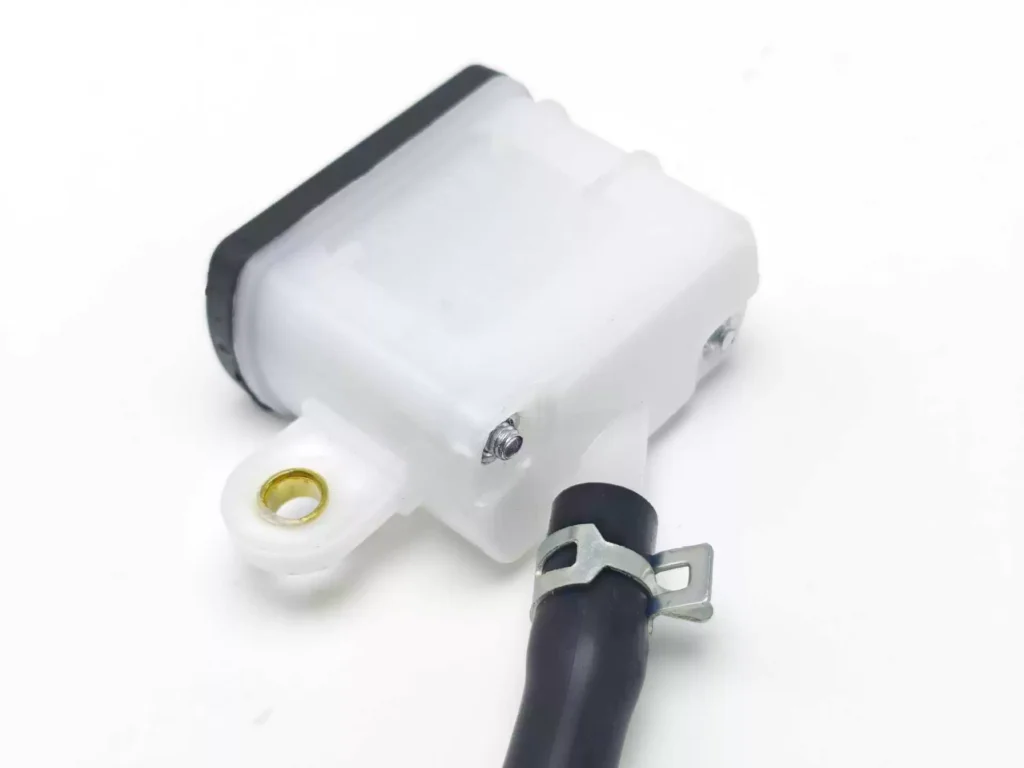
For a wholesale buyer, an unclear reservoir request can produce a quote for the wrong configuration before the order is even placed. A product photo may show the general shape, but it does not identify the vehicle version, hose specification or mounting interface. Use the checklist below to make the supplier quote the same part and order scope you intend to buy.
Which reservoir option is being quoted?
The current VOBOM product listing presents two choices: “Reservoir without hose” and “Reservoir with hose.” Treat them as distinct configurations. The option name tells you whether a hose is listed with that variation; it does not, by itself, define the hose length, end fittings, cap, bracket, seals or other included pieces.
| Listing option | What the option identifies | Confirm in the quote |
|---|---|---|
| Reservoir without hose | The listed reservoir configuration excludes a hose. | Whether the cap, diaphragm, outlet fitting, mounting bracket and hardware are included; whether a separate hose is available. |
| Reservoir with hose | The listed configuration includes a hose option. | Hose length, inside diameter, end fittings, material, clamps and whether the reservoir and hose are supplied as one set. |
Ask the seller to put the selected option name or SKU on every quote line. If you are comparing several suppliers, do not compare a reservoir-only offer with a reservoir-and-hose set as though they were the same item.
What vehicle information should accompany the RFQ?
The product listing uses the broad application label “off-road motorcycle” but does not specify a model or year. Send enough information for the seller to check the exact version instead of treating the category label as a fitment guarantee.
- Make, exact model, model year and destination market.
- Engine or frame code, if available, and the original part number or reference.
- Photos of the existing reservoir from the side, top and connection points.
- A photo of the mounting area and the mating hose or port, with a ruler or caliper scale where practical.
- Requested configuration, quantity per option, sample requirement and delivery destination.
If the original reference is missing or unreadable, say so. Provide a clear sample photo and request the supplier’s written comparison against the relevant vehicle parts diagram or service reference. A model-family name alone may help narrow the search, but the buyer and seller should resolve the exact application before a bulk order.
Which interface details should the supplier document?
Request a dimensioned drawing that labels where each measurement begins and ends. Confirm the reservoir mounting-hole spacing and orientation, outlet position and size, hose length and connection details, and the cap or mounting hardware included in the chosen option. If capacity, level marks or packaging dimensions matter to your market, ask for those values with their measurement basis.
Ask whether listed dimensions and weight refer to the product itself or its package, and whether weight is net or gross. This makes the quote, sample inspection and freight calculation comparable. The current listing’s source does not define that measurement scope, so do not treat a catalogue dimension as a confirmed shipping-carton measurement.
How should brake-system compatibility and quality be confirmed?
A brake component is safety-related, so visual similarity is not enough to establish compatibility. Ask the supplier to confirm the reservoir and hose materials against the vehicle maker’s specified brake-fluid system and the exact application. Request supporting material or test documentation when it is part of your purchasing specification; do not infer fluid compatibility from a photo or a broad product label.
Before approving a production order, agree how the sample will be checked: option and included parts, mounting and connection dimensions, visible finish, leakage or other checks required by your own quality plan, and the approved reference sample. Installation and vehicle-specific service decisions should follow the manufacturer’s service information and a qualified technician.
How can importers compare wholesale quotations fairly?
Use one line per option and ask every supplier to quote the same quantity tiers and delivery scope. The current VOBOM listing shows an MOQ of 200 pieces for each option and indicative product-only pricing; it excludes freight. Treat those as listing references, then confirm current MOQ, availability and price in a dated quotation before ordering.
- Unit price and currency by configuration; note whether the price is product-only.
- MOQ and price breaks for each option, plus sample cost if applicable.
- Availability, production lead time and the quote-validity period.
- Packaging method, pieces per inner pack/carton, carton dimensions and gross weight.
- Named shipping origin, requested Incoterm or freight scope, destination and excluded charges.
- Written fitment decision and the drawing or sample version used for approval.
Copy-and-send brake reservoir RFQ template
Product: motorcycle brake fluid reservoir
Configuration: [without hose / with hose]
Make / model / year / market:
Engine or frame code:
Original part number or reference:
Photos or drawing attached:
Connection and mounting details to confirm:
Quantity by option:
Sample required: [yes / no]
Destination country and postal code:
Please confirm fitment, included parts, material/fluid compatibility,
current MOQ, unit price basis, availability, lead time, packout and freight.
Frequently asked questions
Does the broad off-road application label confirm my model?
No. It is the broad application wording in the current listing, not a compatibility guarantee. Provide the exact model, year and market and obtain the seller’s written application check.
Does the “with hose” option include a cap and mounting bracket?
The listing distinguishes the hose options but does not specify every accessory in the set. Ask the supplier to enumerate the reservoir, hose, cap, diaphragm, bracket, seals and hardware included in the quoted SKU.
Can the listed dimensions be used to calculate the shipping carton?
Not without clarification. Ask the supplier whether each dimension describes the product or package, and request carton dimensions and gross weight separately for freight planning.
Is the listed product price a delivered price?
No. The current product listing describes the price as product-only and excludes shipping. Ask for a destination-specific freight quote and written exclusions.
To review the available reservoir options, compare them with the brake components category, or use the brake lever RFQ checklist for a related sourcing request. Send the option, model evidence, quantity and destination to request a fitment and freight review. This guide is a procurement checklist, not vehicle-specific installation advice.